

- +91 99000 06090
- Discuss your Requirements

A Step-by-Step Guide to Wall Construction Using Solid Concrete Blocks in Bangalore
- 0 Comments
- By SCC SEO
- Latest News Our Blog
- 100 Likes
When you are planning to construct a home, a compound wall or even a small building located in Bangalore, you must have heard people say, Do solid concrete blocks. They are and more robust and trustworthy. And frankly that is some sound advice. The rapid development of the construction industry in Bangalore has elevated solid blocks to high preference of the builders, owners and contractors of buildings.
However, when you are new in construction, the whole process may be overwhelming. In this article, therefore, I will take you through this simple and easily understood step-by-step process of making walls using solid concrete blocks in Bangalore. This is whether you are overseeing your own construction of your home or you are planning on doing any other construction in the future, this guide will help you get the basics of it without needing to go into some vibrate engineering terminology.
The reason why solid concrete blocks are popular in Bangalore.
It is only necessary to have a brief look at the reason why these blocks are so popular in this case:
- They are robust and strong and can withstand heat, rainfall as well as the wet conditions of Bangalore.
- Solid blocks assist in maintaining the indoor environment of buildings cooler, which proves useful in the summer time, particularly around summer peaks.
- They are all the same size hence walls are erected quicker and more presentable.
- They decrease the use of cement mortar as compared to ordinary bricks.
So now we will see the stage by stage construction process.
The wall layout needs to be planned.
Any construction project that is good starts with a plan. The wall plan will be indicated by the engineer or mason on the foundation or slab with the help of chalk lines before the first block is laid.
You can think of it as sketching the outline of a future wall, with straight lines and corners and openings in the form of doors and windows. This marking makes sure that the wall is erected in the place it is intended to be placed.
A small tip from experience:
Many homeowners have overlooked this step and ended up regretting the out of place walls. So when you are in a hurry be sure the layout markings are inspected twice.
Preparing the Mortar
Mortar is the glue that is uniting the blocks. There is a typical blend in Bangalore, cement + M-sand (manufactured sand) and water. The mason blends it until it becomes a smooth paste.
The mortar must neither be too liquid nor so thick. When it is excessively wet, then the wall is weak. In case it is excessively dry, the blocks will not connect.
Installing the First Course (The Row of the Highest Importance)
The initial course of blocks is referred to as the first course and this determines the overall tone of the whole wall. When this layer is absolutely flat, the rest of the wall is more easily constructed.
The mason applies a layer of mortar on the base and taps the blocks into their place with a small rubber mallet. A spirit level is employed to persuade that the blocks are flat and smooth.
Imagine it to be placing the base of a Lego construction, when the first row leans there will be a crooked appearance on the rest of the construction.
The creation of the wall layer in layers.
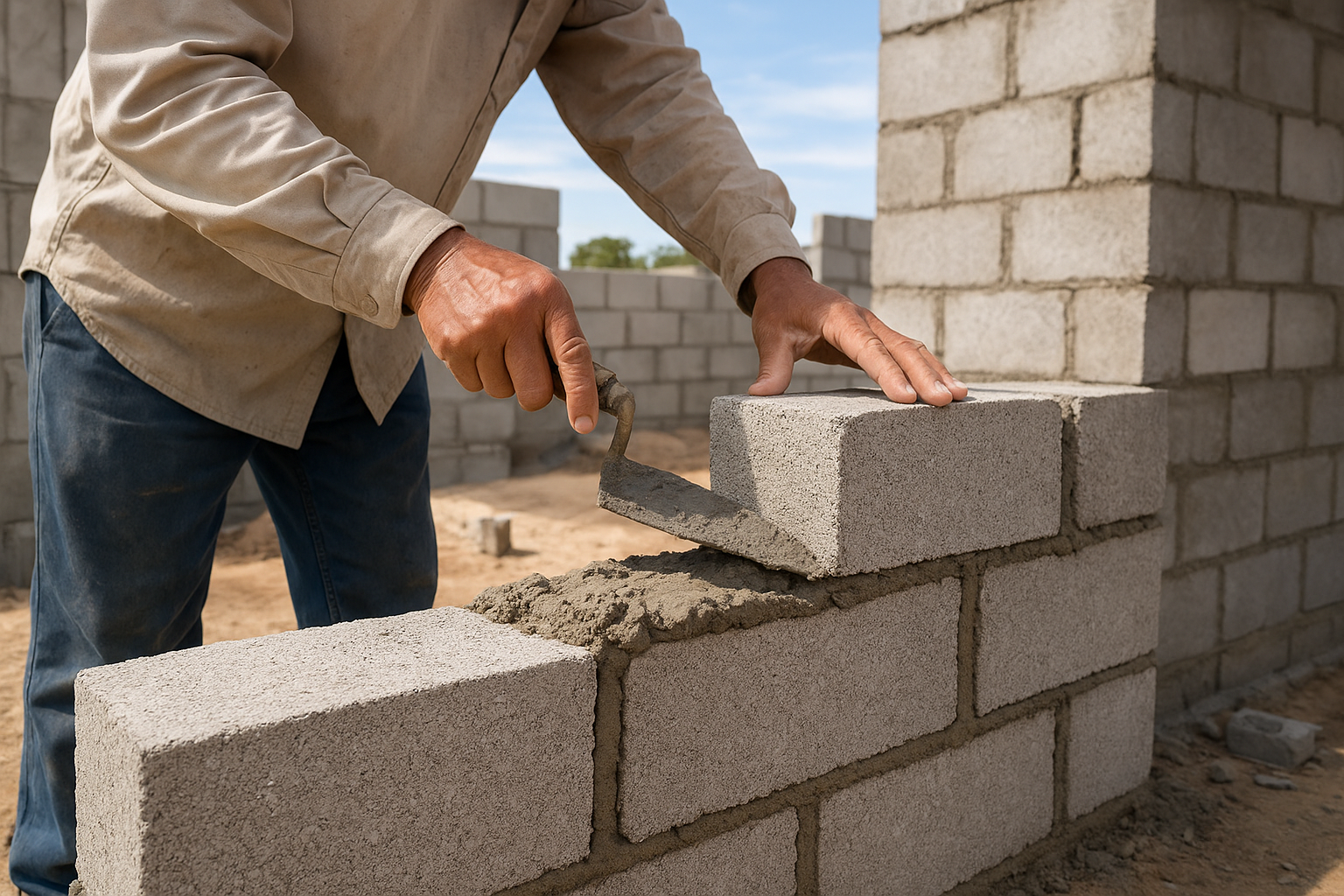
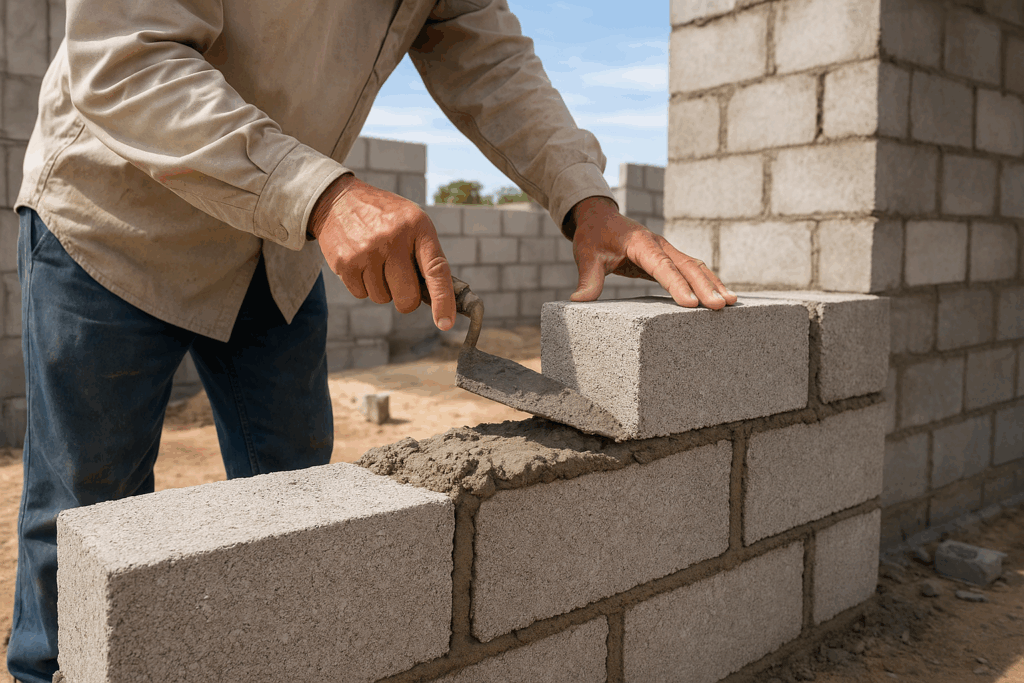
When the initial course is in place, the construction is comparatively quick. One block is also laid on a layer of mortar and on one hand.
The following are some of the points that are usually adhered by masons in Bangalore:
Staggered joints
The blocks are so organized, such that the joints do not align vertically. This provides the wall with extra strength.
Comparing vertical alignment.
Plumb line or aluminium level is used to make sure that wall is not leaning forward or backward.
Maintaining uniform joints
The mortar joint thickness is normally maintained at an even rein to achieve a tidy finish.
With the wall increase, windows and doors openings are duly framed. These openings are thus covered with lintels (small beams of concrete) that support the load.
Strengthening with Curing.
Curing is one of the steps in construction that are the least considered. Once the wall is constructed, it must remain wet during several days in order to allow the cement to harden.
Curing is still further significant in Bangalore because of the warm climate. In case of too fast drying of the wall, cracks might emerge in the future.
In most cases, employees spray water on the wall after a set period or spray wet jute sacks to keep the wall moist.
Step 6: Finalizing: Plastering and Finishing.
After the wall is completely healed, there is the plastering. The wall is plastered to provide a smooth and even surface and it is painted.
The plaster mix is well prepared and applied all over the surface. The wall appears as a new one, smooth, clean after the plastering, and is prepared to continue the other process of construction.
Final Quality Inspection.
The mason or the supervisor checks the wall before declaring it to be complete:
- Alignment and straightness
- Finiteness following plastering
- Any cracks or hollow sounds
- Adequate door and window openings.
This is the last inspection to make sure that the wall is robust and aesthetically fit.
The Reason This Knowledge is Beneficial to the Homeowner.
Although you may not be the one that is actually doing the construction, an insight into this process will assist you in:
- Manage the work without any hesitation.
- Avoid common mistakes
- Guarantee no building delays.
- assure permanence.
Bangalore is a city where labour, materials and land are costly and thus a slight mistake will result in the later enlargement of the problem. Being informed means that you are able to make informed choices.
Summary: How To Construct Strong Walls (The Proper Way).
Building of walls with solid concrete blocks is simple when done in phases. The trick is in appropriate planning, laying of blocks carefully, curing thoroughly and good finishing.
When it comes to constructing a building in Bangalore, then a good choice that you have made is solid concrete blocks; not only because it is strong, but also because it provides better thermal comfort and lasts longer.
Provided you find this guide helpful, you can pass the same to your friends, neighbours or any other people who are constructing a home in Bangalore. And we also wish to remind you to become a subscriber to our blog where you will find more practical and easy to understand tips to construction.